Let’s Close That Knowledge GaP
A lot of people say they don’t feel confident enough to start exercising.
On the surface, that sounds like a motivation issue.
Or maybe a discipline problem.
But that’s usually not what’s actually going on.
More often than not, it’s a knowledge gap.
Your research highlights this clearly. People don’t just struggle because they lack willpower—they struggle because they’re navigating a complex mix of internal and external barriers: low self-efficacy, confusion about what to do, lack of guidance, environmental constraints, and past experiences that shape how they perceive exercise .
When you zoom out, it becomes obvious: confidence isn’t the starting point. Clarity is.
The Problem Isn’t Effort—It’s Overwhelm
We’ve created an environment where fitness feels more complicated than it needs to be.
There are endless programs, conflicting advice, and constant messaging about what’s “optimal.” For someone trying to get started, that doesn’t create motivation—it creates hesitation.
Your work shows that barriers to exercise don’t exist in isolation. They stack across multiple levels:
- Intrapersonal: low confidence, uncertainty, fear of doing it wrong
- Interpersonal: lack of support or guidance
- Environmental: access, time, convenience
When all of that hits at once, the result isn’t action.
It’s paralysis.
And that’s where most people get stuck—not because they’re unwilling, but because they don’t know where to begin.
Closing the Gap Starts With Simplicity
If the problem is complexity, the solution isn’t more information.
It’s simplification.
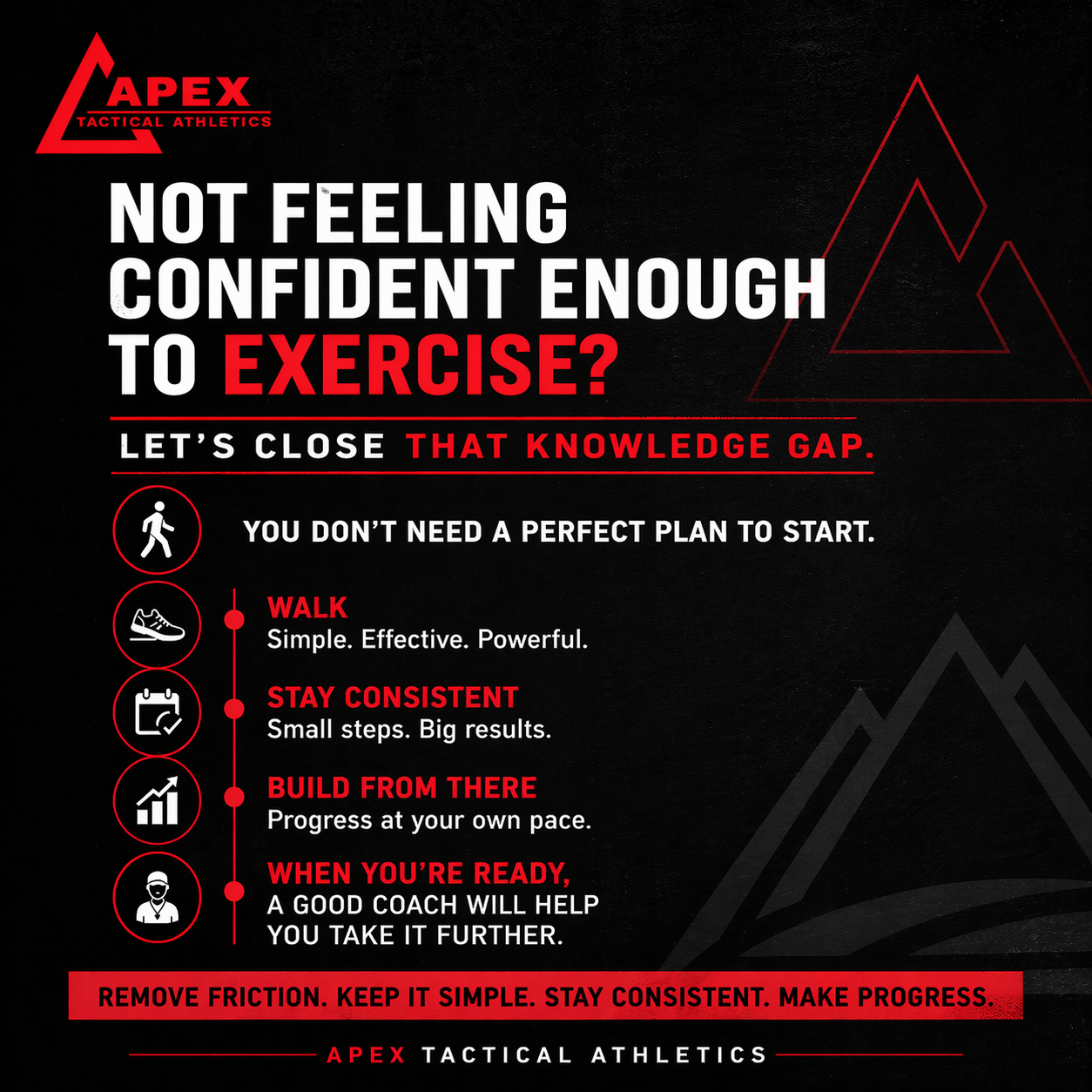
You don’t need a perfectly structured program to start. You don’t need to optimize anything. You don’t need to feel “ready.”
You need a starting point that removes friction.
And one of the most effective, overlooked entry points is simple:
Walk.
Walking requires no learning curve, no equipment, and no planning. It immediately reduces the environmental and psychological barriers that prevent people from engaging in exercise. More importantly, it creates early success—something your research ties directly to improvements in self-efficacy and continued participation .
This matters, because confidence is not something you wait for.
It’s something you build through action.
Consistency Builds What Motivation Can’t
One of the biggest mistakes people make is trying to do too much, too soon.
They go from doing nothing to attempting a full program, with strict expectations and high effort. When that inevitably becomes unsustainable, they stop—and that reinforces the belief that they “can’t stick to it.”
Your findings align with this pattern. Low self-efficacy and lack of adherence are not random; they are often the result of mismatched expectations and poorly designed starting points .
The alternative is much simpler:
Start small.
Stay consistent.
Build gradually.
Walking consistently may not feel impressive, but it does something more important—it creates momentum. It establishes routine. It reduces resistance. And over time, it builds both physical capacity and psychological confidence.
That’s how behavior actually changes.
Where Coaching Actually Fits
There’s a common misconception that coaching is most valuable at the beginning.
In reality, most people don’t need more structure when they’re overwhelmed—they need less.
Where a good coach becomes valuable is after you’ve started.
Once consistency is established, the challenge shifts. Now it’s about progression, direction, and making sure your effort is aligned with your goals. This is where professional guidance addresses one of the key barriers identified in your research: the absence of clear, individualized direction .
A coach doesn’t replace the need to start.
They refine and accelerate what you’ve already begun.
The Takeaway
If you don’t feel confident enough to exercise, don’t mislabel the problem.
It’s not that you’re incapable.
It’s not that you lack discipline.
You’re dealing with a gap—between where you are and what you understand about how to move forward.
Close that gap by simplifying the process.
Start with something accessible.
Remove unnecessary friction.
Focus on consistency over complexity.
Then build from there.
Confidence isn’t the prerequisite.
It’s the outcome.
If you want help bridging that gap and turning consistency into real progress, that’s where I come in.
If you’re ready let’s talk: